"2025 Urban NOA Vehicle Assisted Driving Research Report" Released
Recently, the China Association of Automobile Manufacturers (CAAM) released the 2025 Urban NOA Vehicle Assisted Driving Research Report. The report shows that from January to November 2025, the cumulative sales of passenger vehicles equipped with the Urban NOA (Navigate on Autopilot) function in China reached 3.129 million units, with a penetration rate of 15.1% of passenger vehicle insurance registrations, an increase of 5.6 percentage points compared to the full year of 2024. Market sales are rising rapidly.
NOA, fully known as Navigate on Autopilot, essentially combines "navigation" with "assisted driving" to enable vehicles to drive autonomously on highways and urban roads. This technology has various names among different automakers, including NOH, NGP, NOP, and NCA, besides NOA. According to China's Automotive Driving Automation Classification standard, NOA falls between L2 and L3 autonomous driving, representing the main application domain of current high-level intelligent driving.
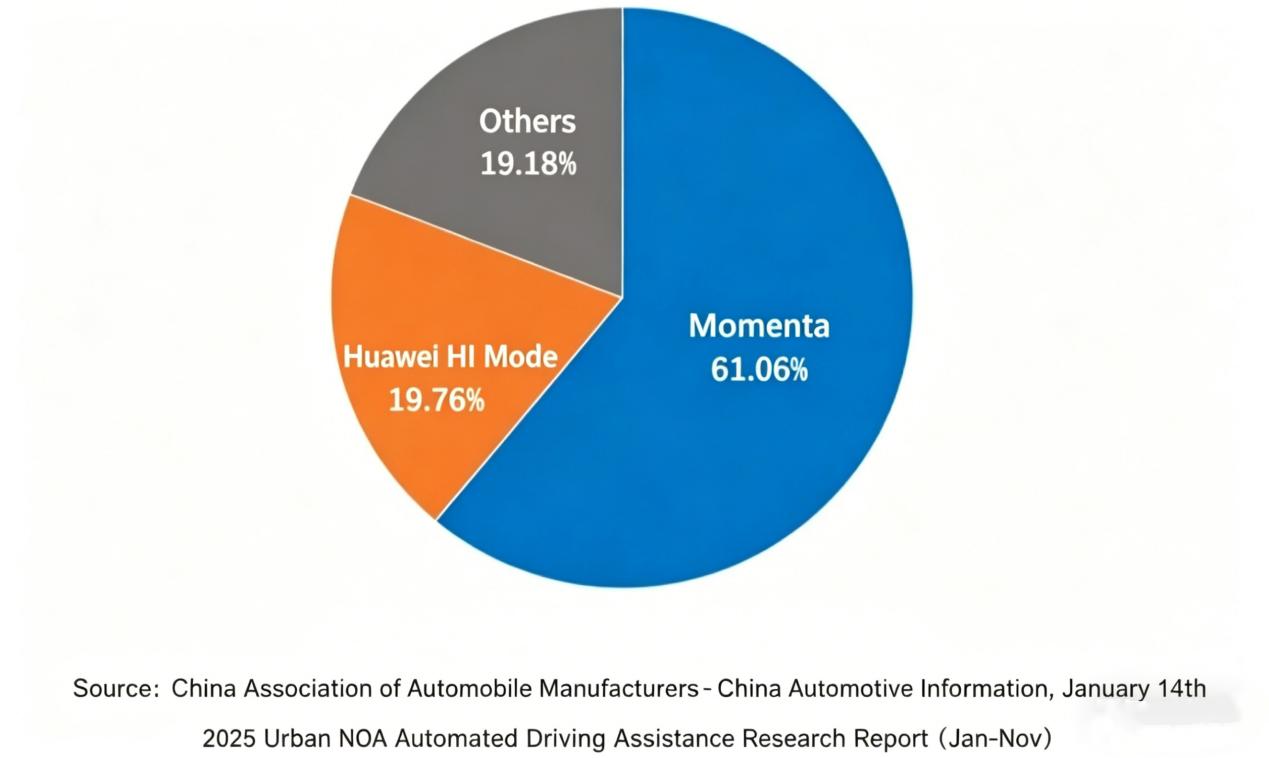
2025 marks a crucial year for the commercialization of Urban NOA in China, with market scale growing rapidly. Currently, the Urban NOA market exhibits a "dual-engine" pattern driven by automakers' in-house development and partnerships with third-party suppliers. While some automakers develop Urban NOA independently, the majority choose to collaborate with third-party suppliers to deploy Urban NOA and seize market opportunities. The current third-party Urban NOA supplier market features a "two-strong" dominance, with Momenta and Huawei as the leading third-party suppliers, jointly accounting for over 80% of the market share. While helping automakers efficiently realize intelligent transformation, they are also jointly propelling the Urban NOA market towards scaled and popularized development stages. According to CAAM data: from January to November 2025, Momenta's Urban NOA installations reached 414,400 units, accounting for approximately 61.06% of the third-party supplier proportion, holding a leading position and covering major domestic mainstream passenger vehicle enterprises. Among the world's top 10 automakers, 8 have established cooperation with Momenta. Huawei's HI model, through strong binding cooperation with enterprises, achieved installations of approximately 134,100 units, accounting for about 19.76% of the third-party supplier proportion.
Mainstream automakers are actively pushing forward, accelerating the popularization of intelligent driving. The report indicates that from January to November 2025, among the sales of passenger vehicles equipped with Urban NOA, domestic brand sales reached 2.5373 million units, accounting for 81.1%. At the same time, facing intense intelligent competition in the Chinese market, globally renowned automotive brands have begun choosing to cooperate with leading domestic third-party suppliers to achieve breakthroughs in the intelligent driving field, upgrading their technology through partnerships with top Chinese intelligent driving suppliers.
The report points out that in the stage of large-scale deployment of high-level assisted driving, algorithm capability, data closed-loop capability, and mass production experience have become core elements determining the market position and development speed of assisted driving suppliers. Successful mass production experience not only provides assisted driving suppliers with resources for iterating technical solutions but also lays a solid foundation for consolidating and expanding their market share.
Driven by both rapid technological iteration and market competition, Urban NOA is accelerating systemic changes in intelligent driving technology routes, core architectures, and industrial ecosystems: in terms of application scenarios, it is rapidly extending from Highway NOA to Urban NOA; in terms of technological transformation, centered on the end-to-end large model, it is driving a deep integrated reconstruction of the system architecture; in terms of industry, as an outpost of high-level autonomous driving, it is accelerating the maturity of vehicle-road-cloud coordination and regulatory standard systems.
The CAAM report highlights that the end-to-end large model has become the core engine for the iteration of NOA assisted driving technology, not only propelling the industry's transformation from a modular architecture towards integrated end-to-end perception and planning but also upgrading the safety experience of intelligent driving.
Various automakers and suppliers are increasing their deployment of end-to-end technology, forming a diversified competitive landscape. New car-making forces are building technological barriers through full-stack self-development, with some leading enterprises already achieving mass production of one-stage end-to-end systems. Relying on training with massive amounts of real road data, they continuously optimize the human-like decision-making level of the system. Traditional automakers, on the other hand, are rapidly bolstering their capabilities through cooperation with third-party suppliers to accelerate technology implementation.
The report further points out that with the integration of multi-modal models and end-to-end technology, as well as the continuous upgrading of computing platforms, the end-to-end large model based on reinforcement learning can further break through the bottleneck of handling long-tail scenarios, pushing the Urban NOA technology to a higher level of driving safety experience and providing a safer and more reassuring intelligent driving experience.
Latest News
Hand-Eye Calibration Analysis: Two Classic Methods from Principle to Engineering Practice
April 24, 2026, 2:38 pm